

During 2025 we moved from a policy based approach to an operational one. The following were introduced or completed:
• Issued a Supplier Code of Conduct covering ethics, human rights, labour standards, health and safety, environmental responsibility, supply chain transparency, conflict minerals, audit rights, grievance mechanisms and remediation.
• Issued a bilingual English and Chinese Supplier Compliance Agreement on Modern Slavery and Human Rights, requiring Tier 1 suppliers to warrant against forced labour, permit unannounced audits, cascade requirements to their own sub suppliers and notify us of any breach.
• Approved a formal Escalation and Remediation Policy setting out containment, investigation, notification and corrective action requirements, aligned to ISO 13485:2016 record retention.
• Published an updated Human Rights Statement in August 2025.
• Launched a public whistleblowing channel on our website, open to employees, contractors, agency staff, suppliers and supplier workers, with an anonymous reporting option, defined response times and a commitment to victim centred remediation including reimbursement of recruitment fees and back pay.
• Established a Conflict Minerals Reporting Template tracker covering 3TG materials, supplier declarations and smelter conformance.
• Delivered modern slavery awareness training to all employees, with role specific modules for procurement, compliance and QA/RA teams.
SurgEase Innovations Ltd is committed to preventing modern slavery, forced labour and human trafficking within our business and our supply chain. This statement sets out the steps we took during the financial year ended 31 December 2025.
SurgEase is not currently required to publish a statement under Section 54 of the Modern Slavery Act 2015, which applies to organisations with an annual turnover of £36m or more. We publish voluntarily because we supply the NHS and international healthcare systems, because we manufacture through a complex and wide-reaching supply chain, and because we believe transparency is the right position for a clinician led company. We hold ourselves to the standard the Act sets for larger organisations.
We also recognise that Regulation (EU) 2024/3015, the EU Forced Labour Regulation, applies from 14 December 2027 to all economic operators placing products on the EU market, with no turnover threshold. Our programme is being restructured around the OECD six step due diligence framework, which the European Commission's guidelines of June 2026 identify as the primary means of demonstrating due diligence. We are equally mindful of the United States Uyghur Forced Labor Prevention Act, which is already in force and relevant to our US sales.
SurgEase Innovations Ltd operates in the medical technology sector in the United Kingdom, designing and supplying digital diagnostic devices and associated software to healthcare providers in the UK and internationally.
We are a small organisation and our supply chain is correspondingly concentrated. We work with 4 Tier 1 critical suppliers responsible for the manufacture and assembly of our devices, located in the Far East, together with a number of UK based suppliers of components, packaging and business services.
We assess our highest inherent risk as sitting in the electronics sub-assembly manufacturing supply chain in Guangdong, and specifically in the upstream mineral supply chains feeding it, rather than in our own UK operations or in our UK service suppliers. We consider the risk within our own operations to be low.
Our assessment identifies 3 principal areas of risk.
The first is migrant labour in electronics manufacturing. The province hosts a very large internal migrant workforce, and recruitment practices, working hour norms and the use of labour brokers vary widely across the sector. Debt bondage arising from recruitment fees charged to workers is the mechanism we regard as most likely to be present.
The second is upstream mineral sourcing. Our devices incorporate printed circuit board assemblies and camera modules, which typically contain tin in solder, gold in wire bonding, tantalum in capacitors and tungsten in components. Published research in 2025 identified elevated exposure among Shenzhen area electronics manufacturers to minerals originating in the Xinjiang Uyghur Autonomous Region, where state imposed forced labour has been documented. None of our suppliers has been named in that research, and this remains a sector level rather than a company specific finding, but we regard it as live and material.
The third is limited visibility below Tier 1. Our suppliers are small and medium sized manufacturers which are not subject to disclosure obligations in their own jurisdictions and do not hold third party social audit certification. This constrains independent verification and is the gap our 2026 programme is designed to close.
Our approach is supported by the following documents, each of which is reviewed at least annually:
• Supplier Compliance Agreement on Modern Slavery and Human Rights
• Escalation & Remediation Policy
• Whistleblowing Policy and reporting channel
• Conflict Minerals Reporting Template tracker and Horizon Scanning Register
Responsibility for the programme sits with QA/RA and Compliance, working with Procurement. Findings and metrics are reported to the Senior Management Team and reviewed at Management Review. This statement is approved by the Board of Directors.
We conduct due diligence on new suppliers before onboarding and monitor existing suppliers on an ongoing basis. Tier 1 suppliers are contractually required to adhere to our Supplier Code of Conduct, to permit announced, semi announced and unannounced audits of facilities, records and worker interviews, to disclose the identities and locations of sub suppliers involved in manufacturing our products, and to cascade our standards through their own supply chains.
We are candid that in 2025 this framework was established rather than fully exercised. 100% of our Tier 1 critical suppliers has signed the Supplier Compliance Agreement by the year end, and we conducted two remote announced site audits and one announced onsite audit during the year. Extending signed agreements into 2027 is our target.
We maintain a Horizon Scanning Register to identify published reports, sanctions designations, legal actions and credible allegations concerning our suppliers. Scanning covers government and regulatory registers, sanctions lists, NGO and watchdog sources, and adverse media.
Our first formal horizon scan was completed in May 2026 and covered 2 Tier 1 critical suppliers. It identified no company specific adverse findings, no sanctions designations and no adverse media for either supplier, alongside the sector level Xinjiang and migrant labour risks described above. As this scan fell after the year end it is reported here as a subsequent event. Scanning will run once yearly for all Tier 1 suppliers, and quarterly for suppliers in higher risk jurisdictions, from 2027 onwards.
Certain materials used in our products may contain tantalum, tin, tungsten and gold, commonly described as conflict minerals because of their association with armed conflict and with forced labour in extraction. We require suppliers to source these materials responsibly, to maintain due diligence systems consistent with OECD guidance and to provide evidence of responsible sourcing on request.
We established a Conflict Minerals Reporting Template tracker in 2025. During the year we received modern slavery and 3TG policy documentation from our Tier 1 suppliers, but we did not receive completed Conflict Minerals Reporting Templates with smelter level declarations. Obtaining completed templates, and mapping 3TG content at part level, is a priority action for 2027 and beyond.
Modern slavery awareness training is mandatory for all employees and is completed annually with 100% compliance. Role specific modules are provided for procurement, compliance and QA/RA teams. Colleagues closely involved in supply chain management additionally complete an accredited course on tackling modern slavery in supply chains recommended by the UK Government. New joiners complete the awareness module within 30 days of starting.
Our whistleblowing channel is published on our website and is open to employees, contractors, agency staff, suppliers and the workers of our suppliers. Reports may be made anonymously. Concerns may be raised about forced labour, recruitment fees, retention of identity documents, intimidation or threats, and unsafe or exploitative living and working conditions, among other matters.
Where a report is received we acknowledge it within 2 working days if contact details are provided, complete an initial assessment within 5 working days and agree an action plan within 10 working days. Where a concern is substantiated our response is remediation first. We require a corrective and preventive action plan from the supplier and we prioritise victim centred remedy, including reimbursement of recruitment fees, back pay and regularisation of contracts. Termination is reserved for serious or repeated breaches, or where remediation fails, because responsible disengagement rather than abrupt withdrawal is more likely to protect the workers affected. Retaliation against anyone raising a concern in good faith is prohibited.
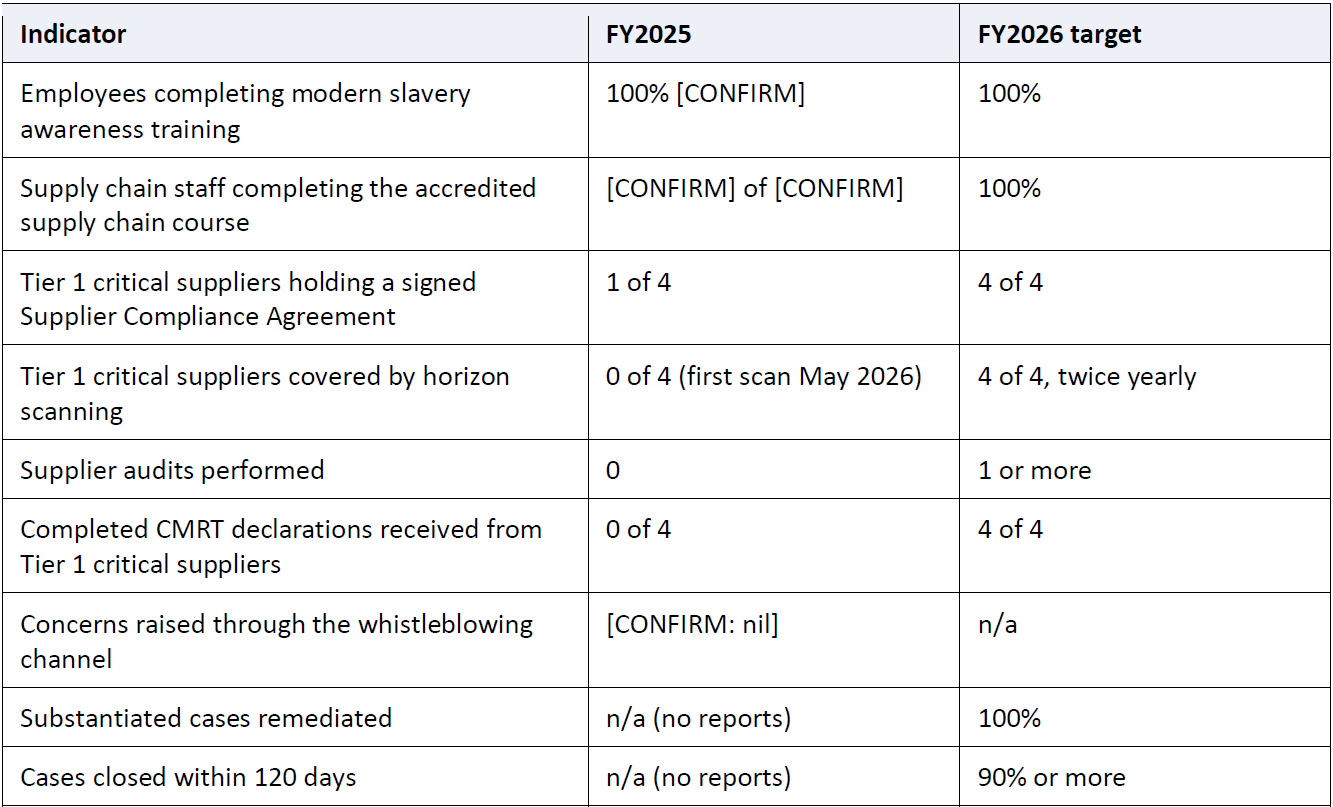
We committed to reporting aggregate metrics against our programme. This is our first year of doing so, and several indicators are reported as nil. We consider an honest baseline more useful than a favourable one.
• Obtain signed Supplier Compliance Agreements from all Tier 1 critical suppliers, with annual recertification.
• Obtain completed Conflict Minerals Reporting Templates with smelter level declarations, and complete part level 3TG mapping.
• Extend horizon scanning to all Tier 1 critical suppliers on a once yearly cycle.
• Add express contractual terms on the Employer Pays Principle, prohibition of identity document retention, prohibition of wage deductions used as penalties, and warranties regarding Xinjiang and state imposed forced labour.
• Issue current Chinese language versions of our Supplier Code of Conduct, Human Rights Statement and this statement, and make the whistleblowing channel accessible in Chinese to supplier workers.
• Commence a supplier audit programme and evaluate third party social audit requirements for suppliers in higher risk jurisdictions.
• Restructure the programme around the OECD six step due diligence framework in preparation for the EU Forced Labour Regulation.
SurgEase Innovations Ltd
Burlington House, 1 York Road, Maidenhead, SL6 1SQ, UK
Phone: +44 (0)1234 567890

