

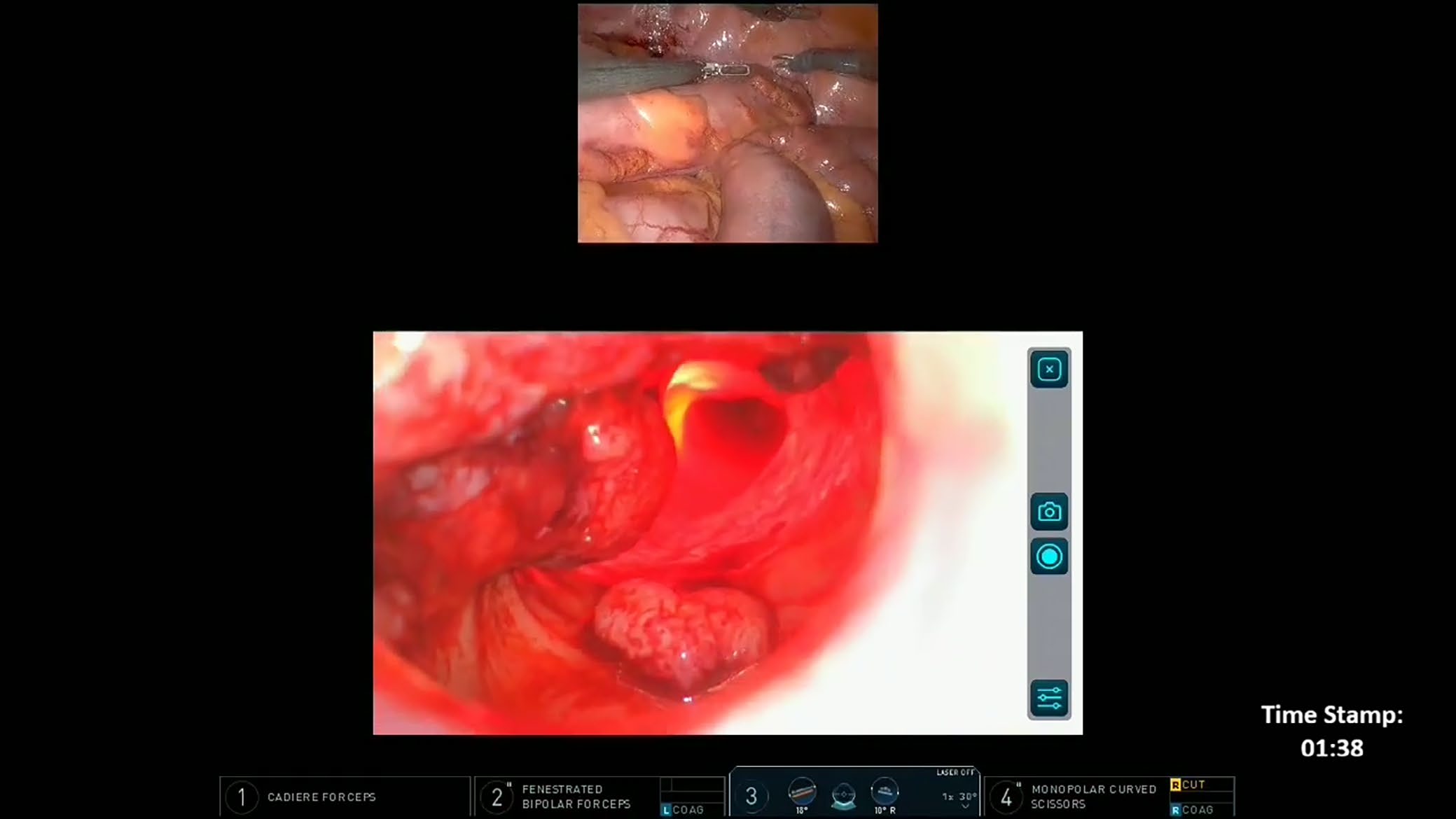
Tumour localisation during robotic resection utilising the Da Vinci robotic platform in conjunction with a digital rectoscope (LumenEye). Video content can be viewed at https://onlinelibrary.wiley.com/doi/10.1111/codi.70347.
LumenEye X1 (SurgEase Innovations, London, UK) is a novel digital rectoscope designed to improve the assessment of anorectal symptoms [1, 2]. LumenEye is a rigid sigmoidoscope attached to an HD screen within a self-contained briefcase-sized system. The LumenEye can be connected to the Da Vinci Xi using the TilePro® function.
Here, we present a video detailing tumour localisation during robotic resection utilising the Da Vinci robotic platform in conjunction with a digital rectoscope (LumenEye) (Video 1). The patient was a 67-year-old male with an asymptomatic rectal tumour detected via bowel screening. Colonoscopy results demonstrated an adenocarcinoma 10–11 cm from the anal verge. MRI staged the tumour as T3aN1.
Following MDT discussion, a decision was made to proceed to surgery. This video (Video 1) demonstrates the integration of LumenEye X1 digital rectoscope with the Da Vinci robotic platform allowing for simultaneous luminal and robotic visualisation for precise tumour localisation and anastomotic assessment during robotic resection. The use of a combined luminal and robotic view using the TilePro® functionality is not a new concept and has been described elsewhere [3]. The advantage of using the LumenEye system is the reduction in relative theatre space/footprint required compared to a conventional flexible endoscopy stack system. We demonstrate accurate tumour localisation prior to division of the mesorectum and rectum itself. The same instrument is used again at the end of the procedure to perform an air leak test and to visualise the anastomosis, checking its integrity, perfusion and for evidence of staple line bleeding.

